How to Study Your Land to Hold More Deer This Season

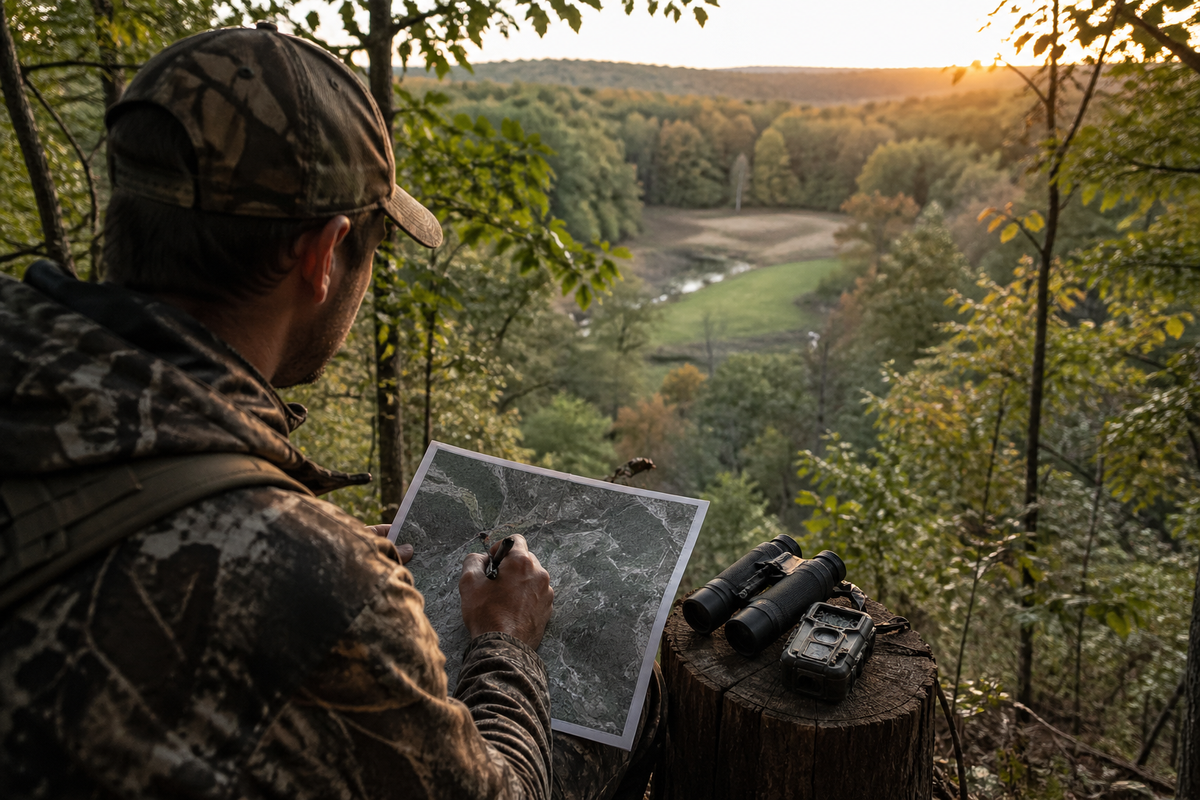
If you want more deer on your property when hunting season rolls around, the real work doesn’t start opening morning—it starts months earlier when the woods are quiet and you’re willing to study your land like a puzzle instead of just walking it like familiar ground.
Most hunters think they “know” their property because they’ve hunted it for years or driven past it enough times. But deer don’t care what you know—they follow patterns built around food, safety, pressure, and terrain. If you learn to see your land through that lens instead of a human one, everything starts to change.
The first step is getting serious about observation instead of assumption. Before you ever hang a stand or cut a shooting lane, spend time just looking. Not hunting, not scouting for immediate setup spots—just observing. Walk the edges of fields, creek bottoms, ridgelines, and thickets and pay attention to how the land naturally flows. Deer are creatures of efficiency. They rarely waste energy moving through difficult terrain unless they have to. They’ll choose the path of least resistance almost every time, especially in low-pressure areas.
Mapping tools can help you speed this up, especially something like onX or topo maps, but don’t let the screen replace boots on the ground. Maps show you elevation changes, funnels, and potential bedding areas, but the woods will show you the truth. Bedding areas aren’t always where you think they should be. Sometimes it’s a thick patch of briars halfway up a slope. Sometimes it’s a bench just off a ridge where wind swirls less than you’d expect. Your job is to find those “why here?” spots—because deer are always answering that question.
Once you start noticing terrain features, shift your attention to food sources. And not just obvious ones like ag fields or food plots. In the South especially, natural browse can be just as important as planted food. Acorns, persimmons, honeysuckle edges, and early successional growth all shift deer movement throughout the season. The mistake a lot of hunters make is assuming deer will stay consistent in one food pattern. They don’t. They rotate based on pressure, mast availability, and even weather. A spot that’s dead in early October might be a highway in late November when acorns are gone and they’re desperate for calories.
Water is another overlooked piece. Deer don’t always live near water, but they almost always move through it or near it. Small creeks, muddy crossings, and low drainage areas can become invisible highways. If you notice consistent tracks crossing a single pinch point in a creek bed, that’s not random—that’s a travel route worth understanding, not just hunting once.
After food and water comes bedding, and this is where most hunters either level up or stay stuck. Bedding is where you start to understand pressure. Deer don’t just bed wherever feels comfortable—they bed where they feel safe. That means wind direction matters more than anything else. If you start paying attention, you’ll notice mature deer almost always bed with their nose into the wind and their back to something solid like a thicket, blowdown, or steep terrain change. If you can identify those bedding areas without disturbing them, you’re already ahead of 90% of hunters.
The key is not blowing those areas out. Study them from a distance. Use glassing points or trail camera placement on the fringes instead of walking straight in. The more pressure you put on a bedding area, the more it shifts or disappears entirely. Deer don’t abandon their core areas—they just adjust how and when they use them.
Wind and thermals deserve their own level of attention. Wind isn’t just “north, south, east, west” in the woods. Thermals rise and fall depending on time of day and terrain. In the morning, cool air sinks into hollows. In the evening, warm air rises up ridges. If you’re not factoring that in, you’re probably educating deer without realizing it. A stand that looks perfect on a map might be completely useless if the wind and thermals are consistently carrying your scent into bedding areas.
Another overlooked piece is human pressure itself. Deer don’t just respond to predators—they respond to people. The more you walk a trail, the more you change how deer use it. That doesn’t mean you shouldn’t scout, but it does mean you need to be intentional. Every step should have a purpose. The goal is to find patterns without creating new ones that work against you.
Trail cameras can help confirm what you’re seeing, but don’t let them replace observation. Cameras show you snapshots in time, not the full story. A buck on camera at midnight doesn’t tell you where he’s coming from or where he goes after. That’s where studying terrain and wind fills in the gaps.
As you build all of this together—food, water, bedding, terrain, pressure—you’ll start to see your land differently. Instead of just “woods,” it becomes a living system with predictable movement patterns. Deer are not random. They are reactive, consistent, and surprisingly logical once you understand the landscape from their perspective.
The hunters who consistently fill tags aren’t always the ones with the best land—they’re the ones who understand their land the best. And that understanding doesn’t come from luck or shortcuts. It comes from slowing down, paying attention, and letting the land teach you what’s actually happening instead of what you assume is happening.
When you finally step into the woods on opening day, you won’t just be hunting deer. You’ll be hunting patterns you’ve already studied. And that’s where everything changes.